

Good Try, We Don't Like It
On The Strokes' "Reality Awaits"

There’s a song on Future Present Past, an utterly forgotten Strokes EP from 2016, called “Threat of Joy.”
I rediscovered it a few months while assembling UNCLE’S HOUSE, I FORGET, a playlist of all the best material not on their first two records. “Joy” is a major jam: neat, clean, catchy as hell. It features just about everything you love from The Strokes, from Julian Casablancas’s effortlessly cool vocals to the dual guitar attack of Albert Hammond Jr. and Nick Valensi. If it doesn’t sound exactly like an Is This It or a Room On Fire song, it doesn’t sound too far off, either. I remember thinking to myself at the time, “Why aren’t there 15 more Strokes songs from five more Strokes albums that sound exactly like this?”
The answer seems to be that there is no answer—not a satisfying one, anyway. It would have been the simplest thing in the world for The Strokes to settle into a B- version of themselves and churn out predictable, mostly decent releases every two to four years. These records would have been filled with songs like “Threat of Joy,” by-the-numbers numbers that could act as a sort of methadone for those of us who had overdosed on “Hard To Explain” or “Meet Me In The Bathroom.”
All things considered, this would be a pretty good reality in which to live, even if it isn’t the one that came to pass. And that’s ok. We have something better.
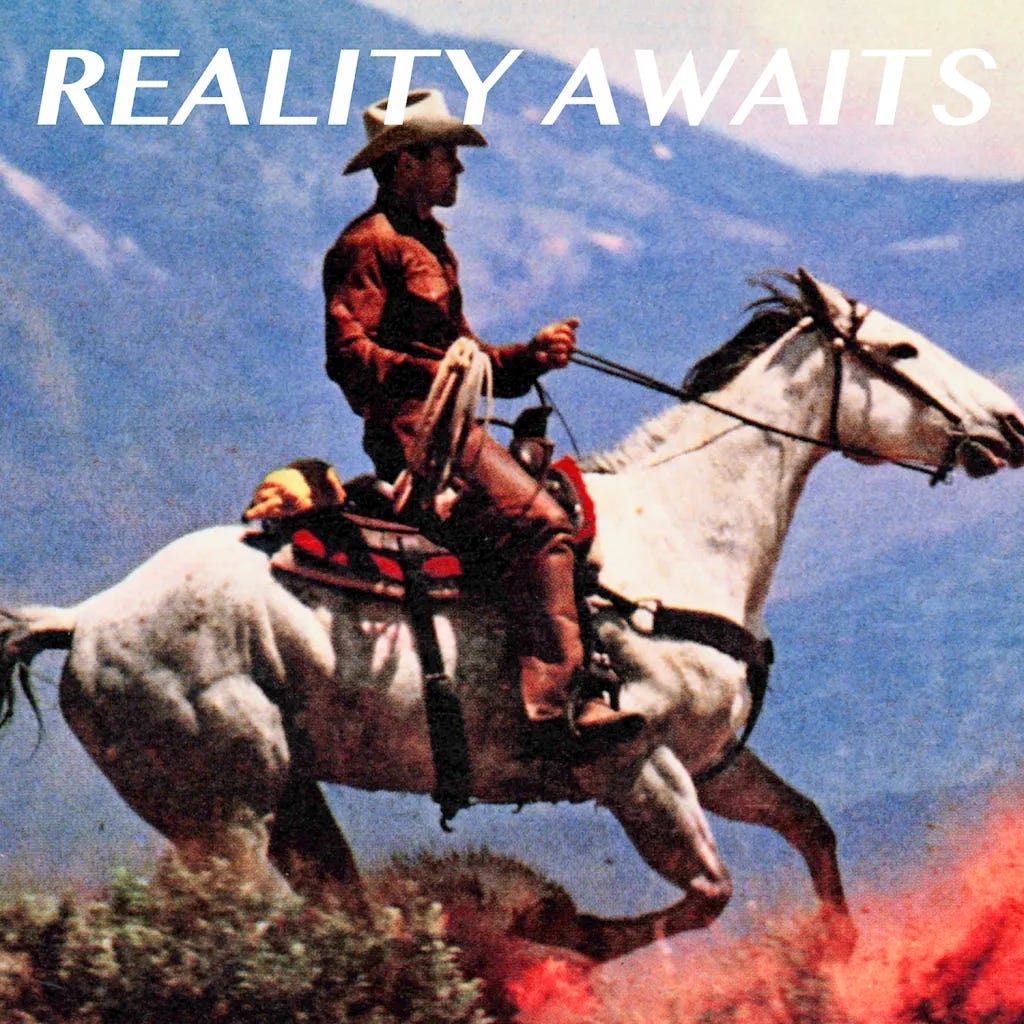
We have Reality Awaits, the long awaited seventh Strokes LP, and their first true release of the ‘20s. Their previous record, The New Abnormal, arrived in April 2020, right as the world seemed to be imploding in the face of lockdowns, mask mandates, and a particularly contagious novel pathogen. Though Abnormal seemed to speak to the times—paranoid, edgy, nostalgic—it was still a document of an earlier era, written and recorded somewhere toward the back half of the first term of the Trump presidency.
In the years since, reality has only grown stranger: uglier, dumber, far more brutish. This has left many artists (including some very good ones) seeming hopelessly out of date, adrift in a fearful new world that bears only passing resemblance to the one in which their music was initially made. Whatever else you might say about them, The Strokes are not one of these bands. Reality Awaits is proof.
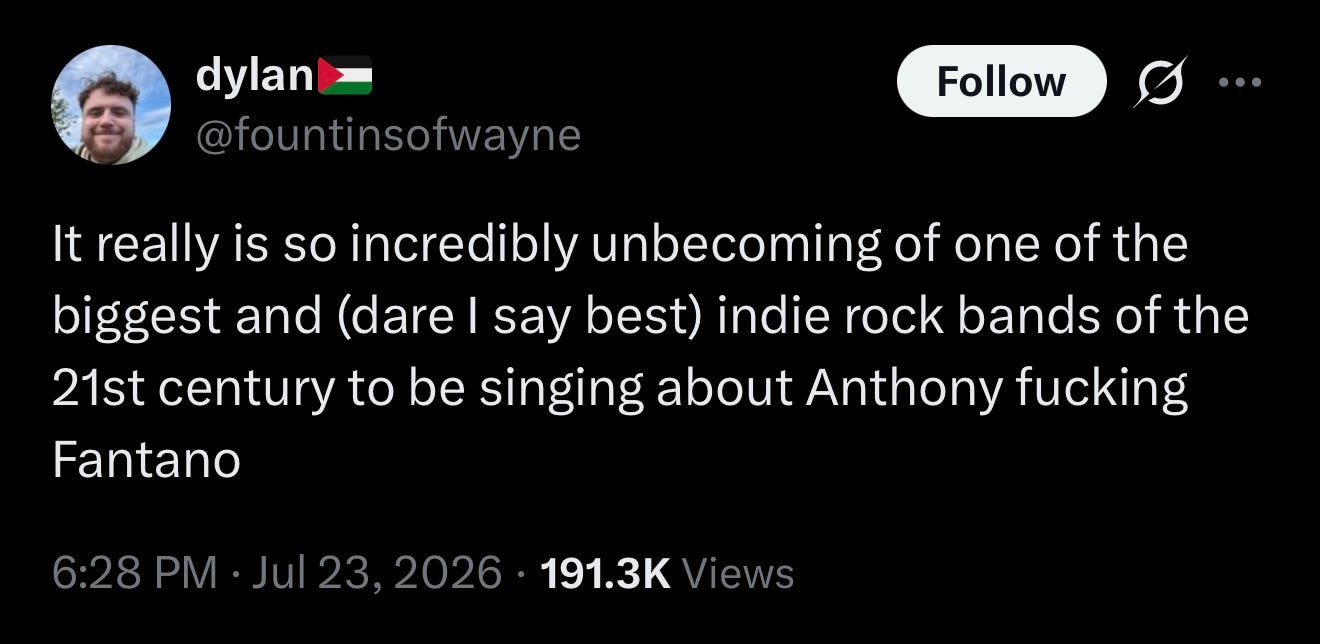
The record is structured around three long, deliberate songs that challenge all expectations of what a Strokes song should be: opener “Psycho Shit,” “Falling Out of Love,” and “Liar’s Remorse.” Together, these tracks act as three legs of a stool upon which more Strokes-y sounding material is piled. “Going To Babble On” is the “Bad Decisions” of Reality Awaits, a New Wave-lite groove that rides a guitar lick you’re sure you’ve heard somewhere before, while “Lonely In The Future” marries a “Juicebox”-like riff with a bright melody that wouldn’t sound out of place on Angles, even as Julian natters on about Harry Styles, John Legend, and Anthony Fantano.
Much of the initial criticism of Reality Awaits (and there has been a considerable amount) has been focused on these supposed “disses,” and how embarrassing it is for an artist of Julian Casablancas’ stature to pick a fight with a lowly critic. To anyone up in arms, I would direct you to Lou Reed’s Take No Prisoners—specifically “Walk On The Wild Side” and the immortal Robert Christgau/toefucker riff.
Lou has always been one of Julian’s north stars, and for better or worse, it seems he still is. If Fantano’s name doesn’t have quite the same cultural cachet as The Dean’s, well, that’s more an indictment of the denuded landscape of music criticism than anything else.
Indeed, one of the most remarkable elements of Reality Awaits is how much Julian seems to have to say this time around. For a man who has made a career out of mumbling meaningless trifles, the sudden verbosity of songs like “Lonely” or lead single “Going Shopping” comes as a bit of shock.
To be sure, he’s no Bob Dylan. There are plenty of clunkers across these nine songs. One early favorite: “Sailed the seven seas, hunted wild rhinocerese.” Another: “Listen to the AI tell you what to do today.” But the contrast between Is This It’s iconically laconic anti-lyricism (“Boys act too much / Girls act too much / Enough is enough”) and the Bozo Mode bitching of Reality Awaits is part of what makes the new record such a compelling listen.
Were these same songs the product of any old journeyman Aughts act, they might sound dissatisfying, if not downright desultory. But this isn’t any old journeyman Aughts act. It’s the motherfucking Strokes. What makes Reality Awaits interesting—what makes it good, and maybe even great—is the band’s willingness to confront and subvert their own legacy.
It’s also worth noting that Casablancas has become increasingly outspoken on political issues, particularly with regard to the genocide of the Palestinian people by the state of Israel. The Strokes were never considered a political band in their heyday. If they were, it was the wrong brand of politics, primarily due to their associations with wealth, fame, and privilege—these guys were “nepo babies” decades before the term entered the cultural lexicon.

Now here they are three decades in, and Julian & co. seem to have developed a political conscious. Is it a cohesive, well-articulated position? Not exactly. But in our existentially polarized reality, it’s sure as shit more compelling than most of what’s on offer elsewhere. “Going Shopping” is a perfect example, with its pointed lines about the difficulty of maintaining solidarity across class lines and the endless allure of treats on offer at the mall. Still, the band keeps things buoyant and propulsive amidst all the glowering, and Casablancas sings the entire song with a heavily AutoTuned whine, giving the proceedings a light glaze of levity. No one should take any of this too seriously—it’s only rock songs, after all.
The prevalence of AutoTune on Reality Awaits has been another fixation of early critics and listeners. It’s a perfectly reasonable element to call out—there is, to be frank, a hell of a lot of AutoTune here. But most of the criticism doesn’t seem to go further than noting its presence. Anyone at all familiar with the band’s work should know The Strokes are no strangers to processed vocals. They were there from the very first line of the very first song, a tinny plea crackling out of a blown out rotary phone. The AutoTune on Reality Awaits may not sound as cool, but it’s no more affected.
To be honest, I find it affecting, especially on “Psycho Shit,” a moody, laborious song that sounds like an album closer but is instead slotted in as opener. One of the keystones of Reality Awaits, the track plays like the credit sequence of a studio system picture, several agonizing minutes you’re forced to sit through before you get what you’re here for (to be clear, this is a compliment). Lyrically, Julian is fully in his feelings, lamenting that “only my beloved songs will define me,” his vocals flitting between semitones in spectacularly halting fashion.
You get the sense—I do, anyways—that he’s compensating for something, that he feels compelled to mask confessional songwriting behind a distant, inhuman voice. It’s like he’s after some sense of plausible deniability. Yes, those are his words, but is it really him?
It’s a deeply vulnerable moment from a man I once believed to be invulnerable. That such a sentiment is paired with tortured similes (“Like poisoned wine, your eyes are mine”) and cornball imagery (“Fuck me now under the moon”) only makes it all the more impactful. The coolest dude around has never sounded so uncool—and he’s somehow all the cooler for it. Call it sonic sprezzatura.
The final third of the album is undoubtedly the strangest. “Liar’s Remorse” kicks off with a feint towards reggae before settling into a maudlin dirge with a conspicuously absent percussion track. If you ever wondered what The Strokes would sound like without Fab Moretti, well, here’s your answer. It isn’t the most compelling thing here (it may in fact be the least compelling), but it adds some interesting texture to the overall package. Penultimate track “Fruits of Conquest” doesn’t do much to pump the energy back up, at least until the extended outro, which pairs a mondo riff and some classic Casablancas self-loathing (“I’m a leech, I’m a leech, I’m a leech, I’m a leech…”).
Despite its title, closer “Tyrants of The Mellow Moon” is an instant classic, with downbeat gunslinger guitar courtesy of Albert, canny syncopated snare fills, and a bonkers Julian vocal that sounds like a malfunctioning robot tuned to both the “cowboy” and “emo” settings. The best song here, and one of the best they’ve ever recorded, “Tyrant” is still an exercise in subversion. Instead of building towards a cathartic conclusion, the song seems to sublimate into the air, a ruined orgasm. For the masters of the album-ending climax—“Take It Or Leave It,” “I Can’t Win,” “Life Is Simple In The Moonlight”—it’s one final challenge to listeners, a good kick in the ass on the way out the door. I simply can’t stop listening to it.
To pick a nit: the album could certainly be longer. After six years away, returning with a nine song, 42 minute LP does feel a bit thrifty. But the relative brevity of Reality Awaits will look better, not worse, over time, as the record settles into its place in a greater body of work. The Strokes seem to have learned their lesson from First Impressions of Earth (secretly their second-best album), which was not quite a double LP but which certainly had two or three too many songs, causing it to lose a bit of steam toward the back half. Better to leave the party too early, it seems, than too late.
But I’m being greedy. Reality Awaits is a striking, purposed collection of music, one that clearly heralds a new era for the group. Halfway through the decade, they’ve already surpassed their achievements of the 2010s. In retrospect, Angles and Comedown Machine sound like interstitial albums, the work of a band that wasn’t sure what it was supposed to be. Whatever else critics may say about it, it’s clear that Reality (along with The New Abnormal) presents a cohesive, cockeyed vision of who The Strokes are in the modern age.
It should also definitively answer the most common question asked of the band over the past several decades—whether any of them even want to be doing this shit anymore. As Julian, Albert, Nick, Nikolai, and Fab all approach 50, four of the five are fathers, and each has (or has had) solo projects of varying quality and success. Live, they’re willing to play their parts, but not much more. Casablancas in particular often seems uncomfortable onstage, lurking in the darkness, mumbling off-mic wisecracks to no one.
Some of it may be an act, sure, but it can’t all be a put on, especially considering the simmering tensions that seem exist between himself and certain members. Which is ultimately what makes Reality Awaits so remarkable. Here is a daring, artistically adventurous record that is bound to disappoint at least some Strokes fans. It is very much not the work of a band phoning it in.
Judging by the takes posted so far, a more predictable set of songs—the hypothetical “Threat of Joy” approach—would have been more satisfying to many. Still, someone would have found a way to take The Strokes to task. At this point, the band seems doomed to disappoint regardless. Room On Fire? Too much like Is This It. First Impressions? Not enough like Is This It. Angles? Both too much and not enough like Is This It. And don’t even start with Comedown Machine.
The only thing more surprising than the sound of Reality Awaits would have been a warm reception from legacy media institutions. One way or another, it was always going to be “good try, we don’t like it.”
I have enough experience with late-era discographies by now to recognize an album like this when I hear one—a misshapen, oddly-paced collection that frustrates, confounds, and infuriates before being retconned into a masterpiece years down the line. Reality Awaits may well be The Strokes’ Shot of Love, or their Death of a Ladies’ Man, or their Love You. I can’t say for certain that it is—the record has been available for all of 72 hours. What I do know, however, is that this an LP made for the long haul: not only today’s reality, but also tomorrow’s.